
Understanding PM2 FAST Results: A Guide for St. Johns County Parents from Tutoring Club of St Johns
Now is the time to prepare for the FAST Test. At the end of each year and the start of the new year, many students will be taking the PM2 (Progress Monitoring 2) assessment for the Florida Assessment of Student Thinking (FAST). At Tutoring Club of St. Johns, we’re here to help demystify these assessments and provide actionable insights. With PM3 (the end-of-year summative test) approaching in May, now is the perfect time to address any gaps and set your child up for success. In this blog, we’ll break down what FAST is, what PM2 scores mean, red flags to watch for, and how our tutoring services can make a difference.
What is the FAST Assessment?
The Florida Assessment of Student Thinking (FAST) is a state-mandated system designed to track student progress in English Language Arts (ELA) Reading for grades 3–10 and Mathematics for grades 3–8. Aligned with Florida’s Benchmarks for Excellent Student Thinking (B.E.S.T.) Standards, FAST is administered three times a year:
- PM1: Early in the school year (August–September) to establish a baseline.
- PM2: Mid-year (December–January) to measure growth after initial instruction.
- PM3: End-of-year (May) for a summative evaluation of mastery, which counts toward school accountability.
These are computer-adaptive tests, meaning the difficulty adjusts based on your child’s responses. Each session is completed in one day, with varying lengths (e.g., 90–120 minutes for ELA Reading). Results are reported on a scale with five achievement levels: Level 1 (lowest) to Level 5 (highest). A Level 3 indicates “On Grade Level” performance.
For detailed scale score ranges by grade and subject, refer to the official Florida Department of Education FAST Fact Sheet. For example:
- Grade 3 ELA Reading: Level 3 is 201–212.
- Grade 3 Mathematics: Level 3 is 198–208.
PM1 and PM2 are informational, helping teachers and parents identify areas for support. PM3, however, is critical—especially for grade 3 students, who need to pass the ELA Reading FAST for promotion (with good cause exemptions possible). Some schools will say passing requires a 2, others will say a 3. This is school-specific. Some will require low-scoring students to attend summer school.
Decoding PM2 Results: Red Flags and What They Mean
PM2 provides a mid-year snapshot after your child has had time to engage with grade-level material. It’s not a final grade, but it’s a strong indicator of trajectory toward PM3.
Key Red Flag: Low Level 2 or Below on PM2
If your child scores a low Level 2 (or Level 1) on PM2, this signals they may not be on pace to achieve a Level 3 on PM3. A Level 2 means the student is performing below grade level, even if it’s enough for basic progression in some cases. For instance:
- In grade 3 ELA Reading, some schools may promote a student with a Level 2, but this can leave them substantially behind in grade 4. They’ll struggle with more advanced content, leading to frustration, lower confidence, and potential long-term gaps.
- Why? A Level 2 indicates foundational skills are weak, making it harder to keep up as expectations increase.
At Tutoring Club, we aim higher: Ideally, students should target a mid to high Level 3 (or above) on FAST to ensure they’re not just passing but truly prepared for the next grade. This sets a strong foundation for future success, reducing stress and building lifelong learning habits.
Other signs to watch for in PM2 reports (available via the Florida Reporting System or Family Portal):
- Low reporting category scores in key areas like reading comprehension or math operations.
- Consistent struggles in benchmarks, as detailed in teacher reports.
Remember, these results are tools for improvement—not judgments. With PM3 just a few months away (May), there’s ample time to intervene.
PM3 is Coming: Now’s the Time to Get Help
PM3 is the big one—it’s the summative score that measures true mastery of B.E.S.T. Standards. While PM1 and PM2 guide instruction, PM3 impacts promotion (especially for third graders) and even eligibility for programs like New Worlds Scholarships for grades K–5 students scoring below Level 3.
The good news? Student need about 8-12 weeks, depending on their currrent achievement level, to prepare and pass the upcoming FAST test. Targeted support can make a huge difference. Don’t wait for PM3 results to reveal gaps—act on PM2 insights today. Early intervention helps students build skills progressively, turning potential red flags into strengths.
How Tutoring Club of St. Johns Can Help
At Tutoring Club of St. Johns, we specialize in personalized tutoring aligned with Florida’s B.E.S.T. Standards and FAST benchmarks. Our expert tutors work with K-12 students to:
- Strengthen weak areas identified in PM2 (e.g., reading fluency or math problem-solving).
- Build confidence through engaging, one-on-one sessions.
- Prepare specifically for PM3 with practice aligned to the adaptive test format.
We’ve helped countless St. Johns County families turn Level 2s into solid Level 3s and beyond. It can take 8-12 weeks or more, so start early. Plus, we’re offering a comprehensive assessment to evaluate your child’s needs and create a customized plan. Stop by our locations in Julington Creek or off CR210 to pick up your free 2025-2026 St. Johns County school calendar magnet—a handy tool for tracking FAST dates and more!
FAST Test Success Story
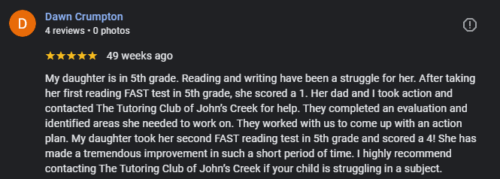
If your child’s PM2 shows red flags, schedule your free assessment today. Mention this blog for 50% off your assessment. Let’s ensure your student enters the next grade ready to excel.
For more resources, visit the Florida Department of Education FAST page or set up a call with us here. We’re here to support our families every step of the way!


Comments