
Florida FAST Testing 2026–27: What St. Johns County Parents Need to Know About PM1
The new school year is underway, and for Florida families, that means the first round of FAST testing is right around the corner.
If your child comes home talking about FAST, PM1, achievement levels, or scale scores, you may be wondering what all of those numbers actually mean—and, more importantly, what you should do with the information.
The beginning-of-year FAST assessment can give parents an important first look at their child’s academic starting point. Rather than viewing PM1 as simply another test, parents can use the results as one piece of information to identify strengths, uncover potential learning gaps, and decide whether additional support may be needed.
What Is the Florida FAST Test?
FAST stands for Florida Assessment of Student Thinking. Florida uses FAST as a progress-monitoring system to measure student performance at different points throughout the school year.
FAST assessments are aligned with Florida’s Benchmarks for Excellent Student Thinking (B.E.S.T.) Standards.
For the 2026–27 school year, FAST includes ELA Reading assessments through grade 10 and Mathematics assessments through grade 8.
Students participate in progress monitoring three times during the school year:
- PM1 – Beginning of the year: Establishes the student’s starting grade.
- PM2 – Middle of the year: Provides another measurement after several months of instruction.
- PM3 – End of the year: Measures student performance after a full year of grade-level instruction.
Looking at all three assessments allows parents and educators to see something that one test score alone cannot show: growth over time.
When Is FAST PM1 in 2026?
For the 2026–27 school year, Florida’s PM1 testing window for students in grades 3–10 ELA Reading and grades 3–8 Mathematics runs from August 10 through September 25, 2026.
Individual testing dates are determined by schools and districts within the state’s testing window, so St. Johns County parents should watch their school’s communication for their child’s specific testing schedule.
Why PM1 Is Different From an End-of-Year Test
One of the most important things for parents to understand is that PM1 happens at the beginning of the school year.
Your child has only recently entered a new grade and has not yet received a full year of instruction on that grade’s standards.
That makes PM1 useful as a starting point.
Instead of focusing only on whether you like the number you see, consider asking:
What does this result tell us about where my child is starting, and where might they need additional support?
That question can be much more useful than simply labeling a score as “good” or “bad.”
Understanding FAST Achievement Levels
FAST results use five achievement levels.
Level 1: Student performance indicates substantial support may be needed.
Level 2: Student may be developing some of the necessary skills but is not yet performing at grade-level expectations.
Level 3: Student is performing on grade level.
Level 4: Student is demonstrating strong performance.
Level 5: Student is demonstrating the highest level of performance measured by the assessment.
Parents may also see a scale score and additional information about performance in different reporting categories.
The achievement level is important, but it should not be the only number you consider.
Look Beyond the Overall FAST Score
A FAST score gives parents useful information, but it doesn’t always explain why a student is struggling.
Two children can receive similar overall scores for very different reasons.
For example, a student struggling in reading might need support with:
- phonics or decoding
- vocabulary
- reading fluency
- comprehension
- identifying key ideas and details
- understanding increasingly complex text
A student struggling in math might have gaps involving foundational computation, fractions, problem solving, algebraic thinking, or concepts from previous grade levels.
That is why we recommend looking at FAST results alongside classroom performance, teacher feedback, and, when appropriate, a comprehensive academic assessment.
The goal is to determine the specific skills behind the score.
What Should Parents Do After Receiving PM1 Results?
First, don’t panic over one score.
Instead, use PM1 as an opportunity to ask better questions about your child’s academic skills.
1. Compare the Score With What You See at Home
Does homework take much longer than expected?
Does your child avoid reading?
Are math assignments becoming frustrating?
Does your child understand the material at home but struggle on tests?
Sometimes FAST results confirm concerns parents have already noticed.
2. Talk With Your Child’s Teacher
Ask whether the FAST results are consistent with what the teacher is seeing in the classroom.
You can also ask which specific skills your child needs to strengthen.
3. Pay Attention to Learning Gaps Early
If a child enters the school year already behind, waiting until spring can make catching up much more difficult.
The beginning of the year provides time to identify missing foundational skills and work on them before coursework becomes increasingly challenging.
4. Consider an Independent Academic Assessment
FAST is an important statewide progress-monitoring tool, but parents may want additional information when a child is struggling.
At Tutoring Club of St. Johns, our assessments are designed to help us identify the specific academic skills a student has mastered and where gaps may exist.
That allows us to build an individualized tutoring plan rather than simply providing more practice in an entire subject.
Why Starting Early Can Matter
Parents sometimes wait for PM2—or even PM3—to see whether a student will catch up independently.
But when there are significant skill gaps, additional months of grade-level instruction do not necessarily correct skills that were missed in previous years.
For example, a student may be working on fifth-grade reading material while still having gaps in foundational reading or comprehension skills. A math student may be learning new concepts while still struggling with skills necessary to understand them.
Addressing those gaps early can help students approach new material with a stronger foundation.
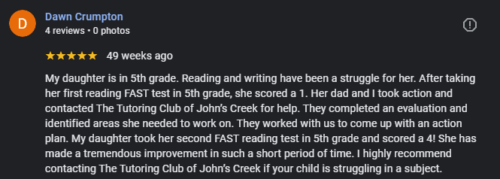
From Struggling Reader to Confident Student
We have seen firsthand how much students can grow when the instruction addresses the skills they actually need.
One of our students came to Tutoring Club during elementary school struggling significantly with reading. Her family had already been working hard to help her, but reading remained difficult and frustrating.
Through individualized instruction, we focused on strengthening the underlying reading skills she needed while gradually building her confidence and independence.
Over time, her academic performance changed dramatically.
What mattered wasn’t simply improving one FAST score. It was developing the skills that allowed her to become a stronger, more confident reader.
Today, she reads because she wants to—something that once seemed difficult to imagine.
That is the kind of long-term change we want for our students.
FAST Is a Tool—What You Do With the Information Matters
FAST gives Florida parents three important checkpoints during the school year.
PM1 tells you where your child is beginning.
PM2 helps you evaluate progress.
PM3 shows where your child finishes after a year of instruction.
The real value comes from using those results to make informed decisions.
If your child’s PM1 results reveal potential learning gaps, you don’t have to wait until the next testing window to start addressing them.
Concerned About Your Child’s FAST PM1 Score?
Tutoring Club of St. Johns provides individualized reading, math, writing, study skills, and test-preparation support for students throughout St. Johns County.
We begin with an academic assessment to identify strengths and learning gaps and then develop an individualized plan based on what your student actually needs.
Give your child the opportunity to start the school year with stronger skills and greater confidence.
Contact Tutoring Club of St. Johns to schedule an assessment and learn where your student stands.


Comments